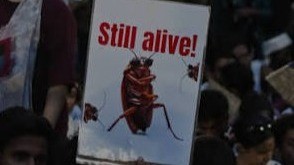
‘You should, at the least, write about it’, he said. And well, I have been trying to. Trying to write. And wanting to write about the cockroaches for days now.
So much has already been posted, memed, filmed, performed and written about it already, that I keep asking myself what remains for me to contribute, especially from so far away, sitting in Germany and watching the movement unfold through Instagram reels, news reports and messages from home.
And yet, I just cannot resist writing. Perhaps because, for me, this story began long before the cockroach acquired wings.
I am returning to, with some trepidation, to a paper I wrote in my own nymphal stage as an early career researcher that was never published. In 2015, during the first year of my doctoral journey, after a successful presentation at a conference, I attempted to write what felt like my first fully fledged academic paper. It examined the populist politics and the linguistic strategies surrounding India’s 2014 electoral win: how political power is established through the interweaving of fantasy and everyday language, metaphors, repetitions, personifications, humour, and carefully manufactured images of the nation and its (anti-national) Others.
By performing a close reading, I examined how an ‘us’ was created through possessive pronouns and intimate forms of address, and how a corresponding ‘them’ was pitted against the us through ridicule, diminutive nicknames, ideological polarisation and the belittling of dissenting voices. One of the most powerful and striking features of the campaign was its linguistic naturalisation of political power through slogans whose rhyme, repetition and almost hypnotic (or pre-meditated algorithmic) circulation forestalled critical distance, allowing them to enter seamlessly into the realm of common sense through the scrolling personal touchscreens floating within the intimate spaces of everyday life.
The paper was accepted subject to revisions but inadvertently omitted from its intended volume. After repeated reminders, the professor apologised and passed to a second collection which I was also expected to co-edit. After months of waiting and some co-editing work, the collection never materialised and the other professor also later apologised. After slipping through two publication plans, the essay returned to a folder on my computer, where it has remained ever since.
For a doctoral researcher just beginning to find her intellectual voice in a foreign land, this felt like more than an editorial mishap. I had invested months in the paper and imagined it as my first meaningful entry from local into a global academic conversation. Its disappearance left me deeply disappointed and discouraged, but it also made me more politically conscious. Not just of the precarity of academic labour, but also of academia and the Left’s own failure to create lasting spaces in which young critical scholarship could be heard and sustained.
Today, more than a decade later, the act of reopening the paper carries both the burdens and the possibilities of the past. Perhaps also of the present and the future.
I find myself returning to the paper’s central concerns through the extraordinary political life of a single word now echoing across student life in India: Cockroach.
A metaphor reported from India’s highest court seeped through the courtroom drains and into the streets. And what fascinates me are the idiosyncratic roots and routes of this metaphorical seepage: how the courtroom language of insects is seized and digitally reworked and reproduced by young protesters into satire; through masks, memes, usernames, Kafkaesque intertexts and references to Indian literary and popular cinematic cultures; and finally from digital platforms into the streets. All crystallising somehow into a shared political identity.
In my doctoral and postdoctoral research, I examined the ecological, biological and epidemiological language through which societies construct their Others: refugees imagined as floods, migrants and minorities as parasites and enemies as viruses infiltrating the national body. Indian cinema and popular culture have long circulated a similar language of degradation through expressions such as ‘gandi naali ka keeda’ where such metaphors do not merely establish the difference between the ‘pure’ us and the ‘dirty’ other; they render certain people contaminating, invasive and disposable, turning political questions into matters of national purity and embodied belonging.
The Cockroach movement reverses this grammar as the supposedly subaltern creature begins to acquire wings and dares to speak. The meme acquires a body as the reel enters the real street, and the real street turns into a reel you can’t escape both scrolling and strolling through.
What is outstanding is that these (mostly Gen Z-led) student protest hacks frustrate many forms of regularities and singular readings of value judgments. Their aesthetic and narrative techniques and forms are forging a new vocabulary of collective resistance. As a student of literature, one can argue that literary movements have long proceeded through similar acts of formal rebellion. Parody and satire do not simply mock an inherited genre; they expose its conventions, unsettle its authority and generate the possibility of new forms. And something similar is occurring in these reels as they transform the genres through which protest narrates and can become narratable.
Instead, having scrolled through some of them, I could go as far as to propose that some of their ‘hacks’ are questioning the very inherited structures of law, judgments, morality, language and cultural values. What happens when the language of legal judgment ceases merely to adjudicate conduct and begins to classify a generation as verminous, invasive, and disposable? Or when a young protester parodies an older masculine authority, is the reel merely ridiculing an individual, or exposing the ageist and patriarchal structures through which authority speaks? When protesters use the national anthem strategically to interrupt police action and delay their removal, they do more than invoke a national symbol. They expose the contradictions embedded within it, turning a marker of state authority into a temporary shield against the state itself. But when irony becomes the dominant political mode, does it create a genuinely democratic space for dissent, or does it risk rendering every political claim equally unstable?
Virality and visibility are neither guarantors of solidarity nor justice. A reel is not an organisation, and a meme is not a political programme. And clearly, no generation is inherently emancipatory merely because it has learned to speak the language of algorithms. So what now?
The campaign I examined in 2015 had already demonstrated the immense capacity of social media to manufacture intimacy, circulate simplified antagonisms and turn politics into a consumable spectacle. What I want to understand now is whether the same technologies can also sustain the counter-publics that question that spectacle.
Perhaps the reel can become a record, and the meme can become political memory? The joke can expose the ambivalence and absurdity of institutional power, and well, a generation trained to experience systemic failure as personal inadequacy can begin to recognise a collective injury? Perhaps the ‘people’ refuse to remain merely the rhetorical object spoken for by politicians and instead become a public capable of speaking, remembering and holding power accountable?
I ended my paper in 2015 by recalling a question posed by the professor who taught my first undergraduate Political Science class: Given a choice in a democracy, would we choose weak leadership with strong party governance, or strong leadership with weak party governance? My answer then was that, in a democracy, I would still choose a strong public, a public that must never be taken for granted by those elected by it.
I return to that answer now. But I also return to these questions as a teacher. I have just wrapped up a seminar at the University of Heidelberg on nation and multispecies belonging in intermedial narratives. Throughout the course, we asked how belonging is narrated, whose consciousness is made available to us and through which formal techniques human and nonhuman lives become visible, audible or disposable.
These are also the questions I want to leave my students and myself with as we encounter the aesthetic forms and narrative techniques of the student-led protest:
Whose consciousness is presented most fully, and how? Who becomes the focalising centre of the protest narrative? Which narrative mode is pitted against which other mode? Who occupies the position from which events are judged? Do the reels offer us a stable moral perspective, or do contradictory value judgements coexist within them? How do parody, satire, music, bodily performance and digital editing shape what we are invited to admire, condemn or dismiss? And what happens when the very form through which protest speaks begins to question the language and cultural values by which protest has traditionally been judged?
Perhaps the unpublished paper was not entirely lost. Perhaps it was the beginning of a longer intellectual journey…
When the cockroach begins to speak or begins to narrate the nation, the question is not only whether we hear it. It also means asking: do we want to hear it? Are we even capable of hearing it? And do we realise how the form of the speech changes what we are capable of hearing?

