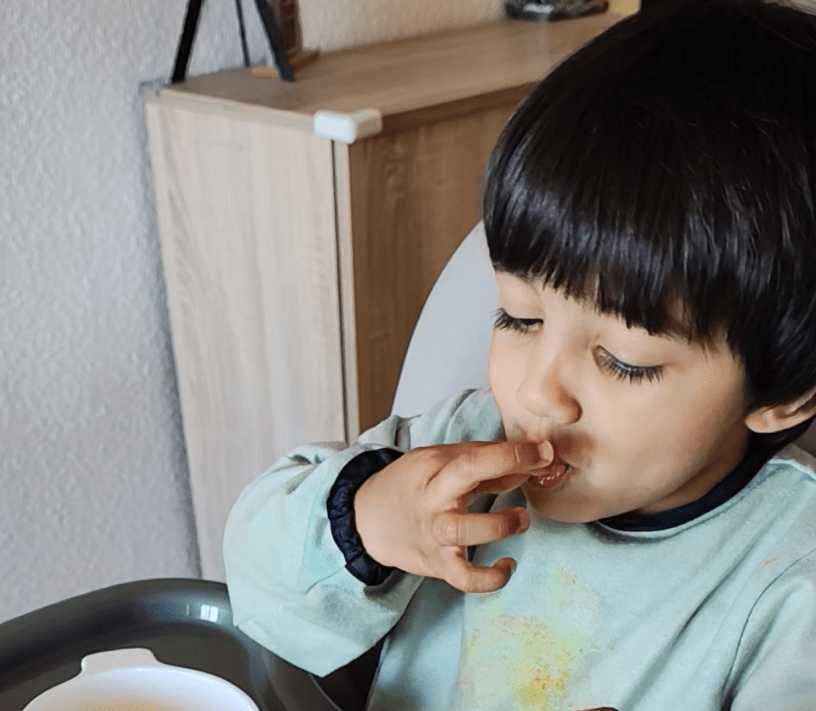
Context: It was just another evening at the dining table. Ru was in his high chair. I was right beside him while monitoring his plate of food. As expected, a few bites in, Ru was already wriggling to get out and play. Again, as expected, I digged into my usual bag of tricks to keep him seated. A book with an interesting story! I picked one of our recent borowwings from the city library…CS Lewis’s The Lion, the Witch and the Wardrobe.
While Lewis chronicles Aslan, a noble lion who breaks the witch’s winter curse over a magical land, I was hoping his book could work some of that magic at our dining table… of breaking the real curse that all parents of two-year-olds know too well…the natural spell of the universe… the resistance of a child who refuses to sit still and finish dinner.
Anyhow, I leaned in and trying to arouse curiosity.
Me: Ru, look what I got! A story book about a lion! Want to know more? Should I read it for you?
(His curiosity piqued just enough for me to hope I could pull off a little bargain… pausing at just the right moments while reading and saying, “You want to know what happens next? Then take a bite! But half way through, reality crept in. Ru knows me too well by now because he had seen right through my little bargaining trick! So I tried the moral route.)
Me: Ru, Papa made the food with so much love. And think of all the farmers who helped us get this food.
Ru: (after his classic thoughtful pause) Mumma, what about the lion? What will the lion eat? Lion is hungry.
Me: (laughing!) Ru, don’t act smart with me. Lion will eat other animals. That is what lions do or else lion won’t be a lion. (Then, in a mood of kidding, yet genuinely wondering, I turned to my husband saying) Arre listen, imagine if we actually gave a lion a sandwich. I mean, it would probably just reject it, right? Or ignore it completely. I guess they naturally don’t feel inclined towards vegetables and bread. But what if we hid the sandwich inside a big loaf of meat? Do you think it might mess with their taste buds? Like what if they start preferring that over plain raw meat? Wonder if humans have already performed such experiments?
(At this point, Ru was silent because he was listening carefully! Clearly picking up every word and nuance of what and how everything is being said, even though I was not talking to him).
My husband: (laughing!) Your imagination can be so wild sometimes…goes from nowhere to everywhere!
(The whole table was now a mess of giggles. Trying to regain order, I turned back to Ru in my most serious voice)
Me: Ok! Ru, enough of laughing. Please eat this sandwich. Who else will eat it otherwise?
Ru: (without missing a beat and standing up on his high chair while grinning and declaring as if he is done with his dinner) Lion will eat it!
(As usual, we couldn’t control our laughter!)
Clearly, my own meandering stories turned around and bit me. And the same night, while jotting down this incident and smiling at Ru’s innocent yet sarcastic declaration that “lion will eat it”…I began reflecting on my own little act of wonder of imagining how a lion might react to a sandwich and I suddenly felt a twinge of guilt. My thought was also so human-centric. And I am now saying to myself why am I thinking of trying to make wild things like us…In my own way, I am falling into the same old net which at first seems like an experimental human urge to understand the wild, but ends up being that of reshaping them in our image. Almost like modifying nature to imagine it based on our terms and taming them in the process. Clearly we need to stop carelessly dumping our human urge and impulse of experiments on nature, and often even our actual mess onto creatures that were never part of creating that mess in the first place. Some things are meant to stay wild and maybe the stories we tell are just our creative ways of imagining them differently, 0r letting them stay that way.
I mean I want stories to imagine the wild to bring us and our children closer to it, to make them care. And yet I don’t want those stories to reduce wild things into harmless symbols or fantasy creatures we can be irresponsible with. Like, of course, I want to keep feeding Ru stories and definitely do not want to raise a child who leaves half-eaten sandwiches behind (he did eat the entire sandwich but it required him to get out, and not be strapped to a high chair…he played around while we snuck in the last few bites)…because alongside a habit of valuing what is on the plate, where the food has come from, etc…we want him to carry his wildness with wonder and hold onto that beautiful mix of curiosity and care. I mean, in the middle of it all, he was the one who first reflected and asked, “Mumma, what about the lion? What will the lion eat?”
And that’s the thing, right? Especially in the later stories of Lewis’s Narnia… Aslan, the lion becomes a symbol of magic, prophecy, etc. Instead in a profound sense, even a symbol of human impact on nature and preservation of wild life. But in the act of a human writer creating this character, and then a human reader imagining it, the lion often gets reduced to symbols. Of course, we need the imagination and the symbols. The very thing that defines and distinguishes us as humans. Or else how would we even tell a story? But in the act of imagining, how careful and responsible we must be. We got to wonder about the act of wondering this life without the motive of owning it, and to tell stories that keep the wild alive and not overwrite it. It is as simple as this: yes, we need writers and readers imagining Aslan and reflecting through it, but we also need them to reflect on Aslan, who in the first place, is a lion, a real, wild, hungry animal. Just like the one Ru was thinking about.
 Dr. Jayana Jain